Scope of work template for client projects
A scope of work is the part of your proposal that says exactly what you will deliver, what you will not, and how both sides will know the job is done.
Most disputes with clients do not start with price. They start with a scope that was never written down.
Below is how to structure a scope of work for service businesses (studios, agencies, freelancers and consultants), section by section, followed by three filled-in examples and a checklist to run before you send it.
Project summary
Open with two or three sentences: what the client needs, why now, and what success looks like for them. Someone new to the project should understand why it exists from this paragraph alone.
- Name the client and the person who approves the work.
- State the business objective the work supports, not just the task.
- Add a measurable outcome if one has been agreed.
Deliverables
Name the thing, not the effort. “Logo design” is an effort. “Primary logo, secondary mark and favicon, delivered as SVG and PNG” is a deliverable a client can check.
- List each deliverable with its format and quantity.
- Say what each one includes, in plain words.
- Write revisions as a number, for example two rounds of consolidated feedback per deliverable.
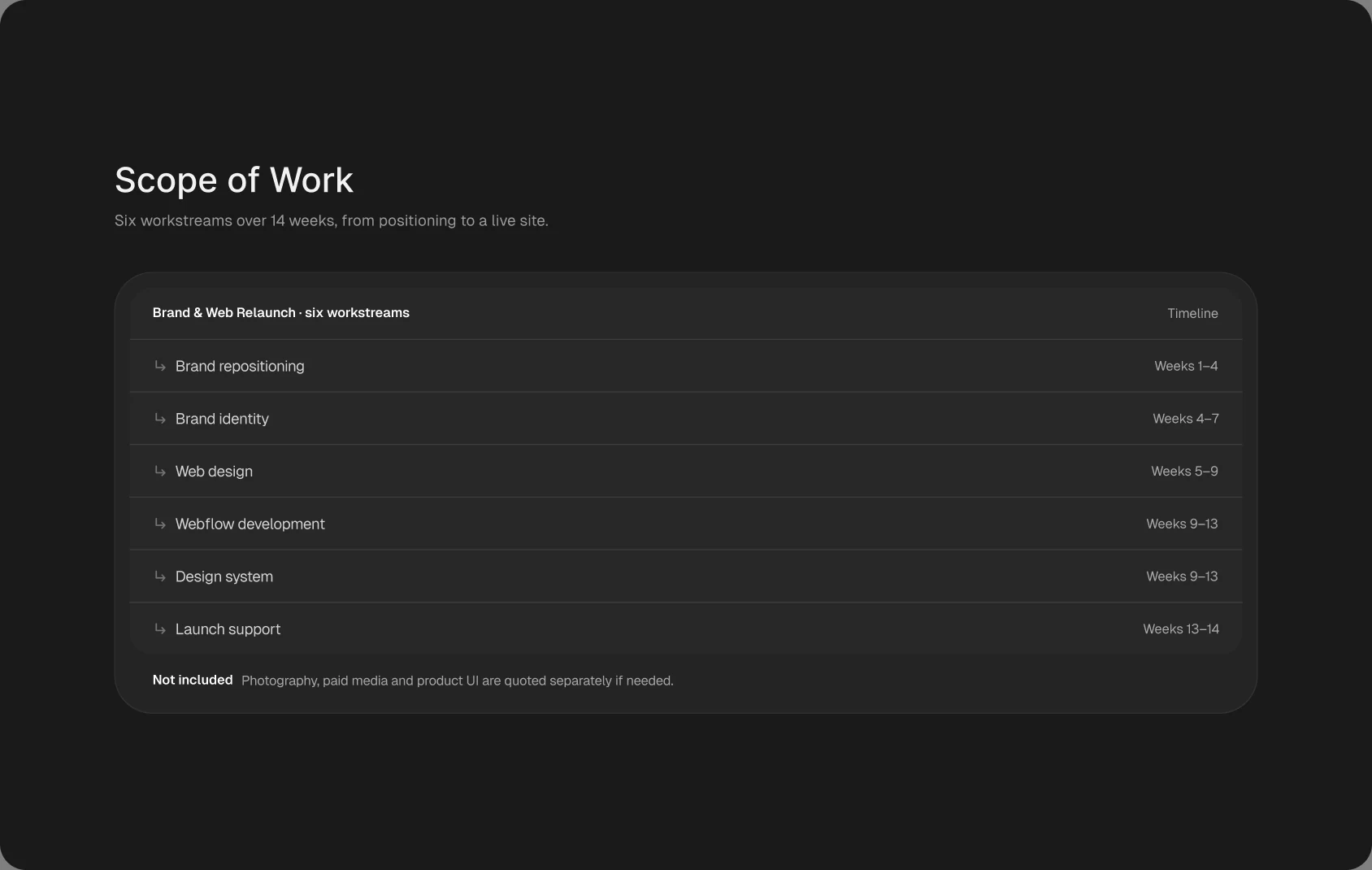
Out of scope
Write it even when it feels obvious. Everything you leave unsaid is something a client can reasonably assume is included. Listing exclusions is not defensive: it is what makes the price readable.
- Common exclusions: copywriting, stock licences, printing, media buying, hosting.
- Extra revision rounds beyond the ones agreed.
- A line saying that excluded work can be quoted separately.
Team & responsibilities
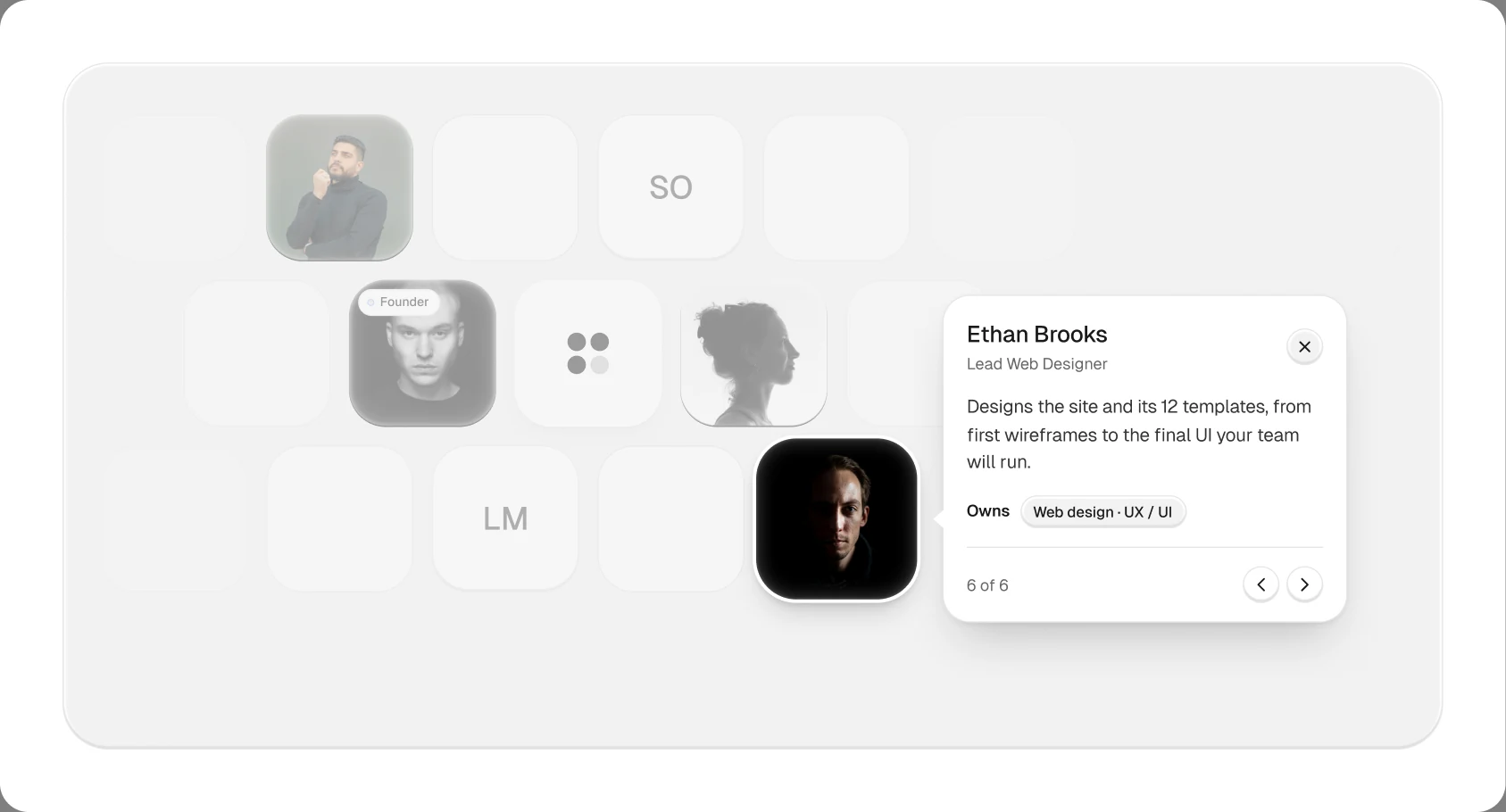
Say who does the work and who decides. When every deliverable has an owner on your side and one approver on the client’s side, feedback reaches the right person and nothing waits on a question nobody owns.
- Name the lead on your side for each deliverable or workstream.
- Name the one person on the client side who gives consolidated feedback and approves each stage.
- List what the client provides and by when: content, access, brand assets.
Timeline & milestones
Tie dates to the client’s feedback. A timeline that does not say what happens when feedback is late becomes your problem the first time it is.
Define “done” here too. Without an acceptance rule, a project can stay 95% finished for months, and so can the final invoice.
- One milestone per delivery or approval, each with a target date.
- A feedback window, for example three business days per delivery.
- An acceptance rule: a deliverable is accepted when the client approves it in writing, or after a set number of days without a change request.
Change requests
Agree the process before you need it. The clause matters less for the money than for the conversation: it gives both sides a neutral way to say “that’s a change”.
- Anything outside the listed deliverables and included work is a change.
- The provider sends a written estimate of the cost and timeline impact.
- Work on the change starts only once the client approves that estimate in writing.
Fees & payment terms
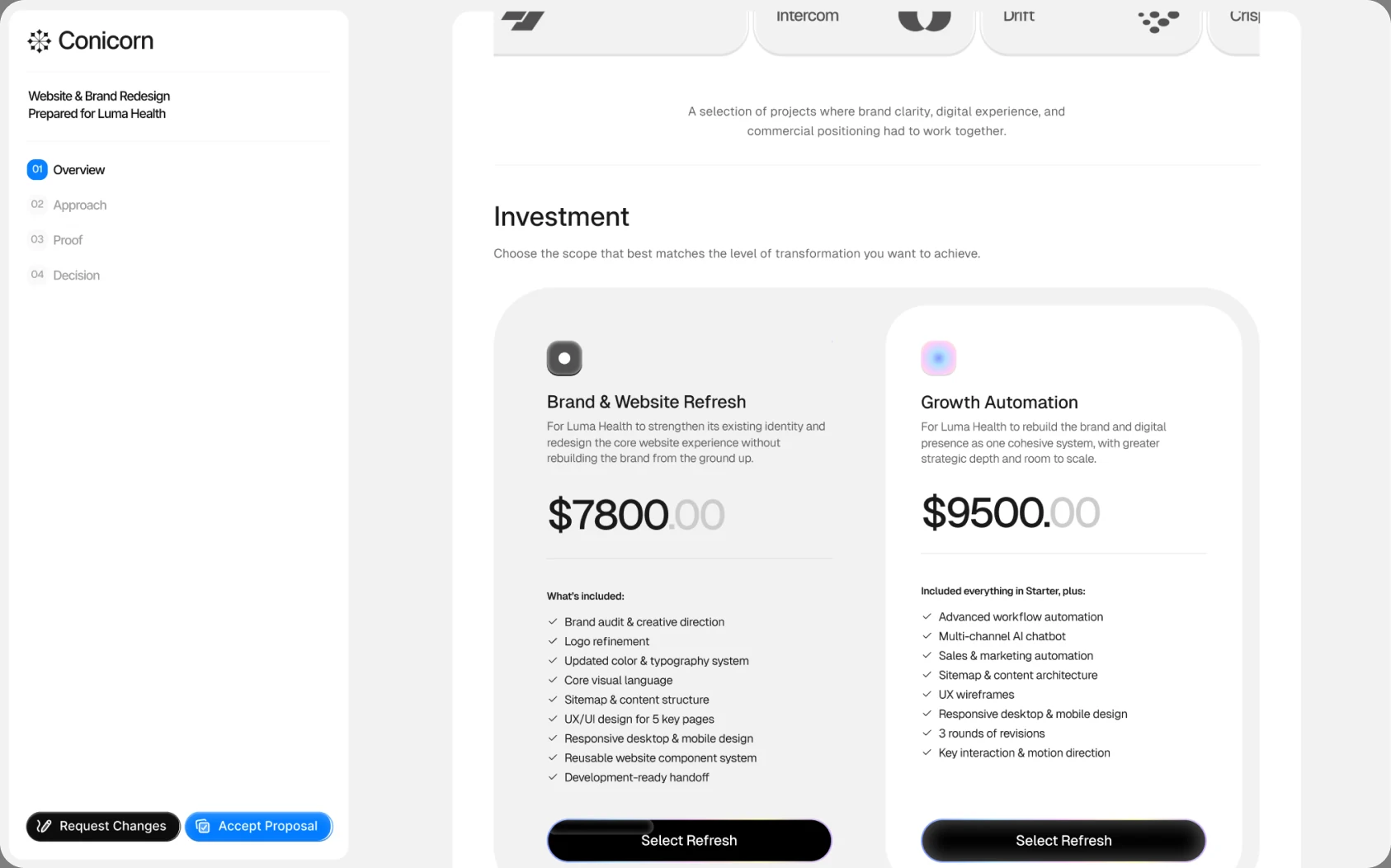
Match the payment schedule to the delivery schedule, so money moves when work does.
- The total amount, the currency and the structure: fixed fee, milestones or retainer.
- A deposit on signature, for example 50%.
- Milestone payments and the balance, each with its due date.
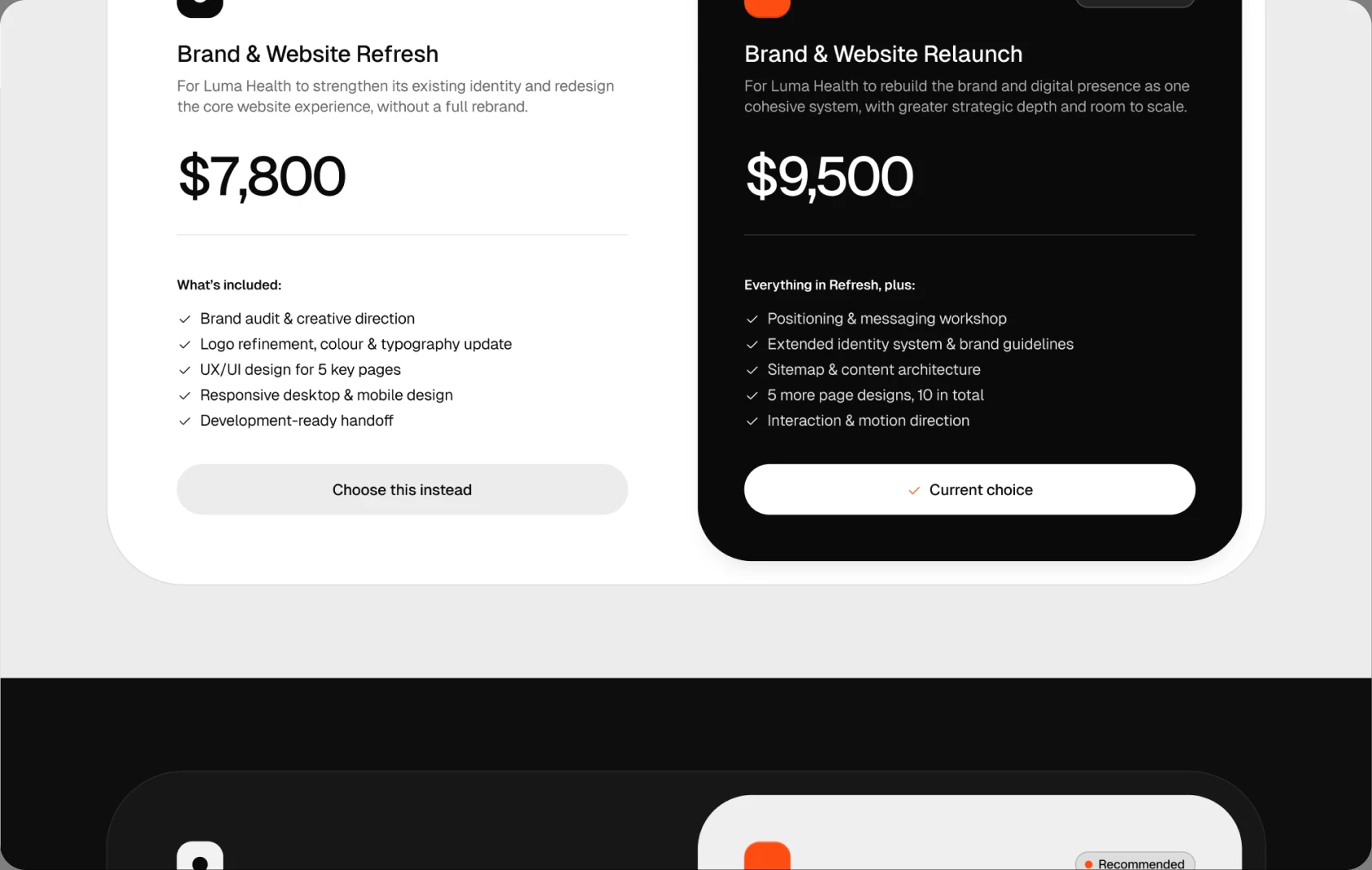
Scope of work examples
The three examples below use a fictional client, Northfield Coffee Co., and illustrative figures. They show the level of detail, not market rates.
Example 1: Brand identity project
- Summary. Northfield is opening two new locations in the spring and needs a brand identity that works on packaging, signage and social.
- Deliverables. Brand strategy summary (1 × PDF, 6 to 8 pages) · primary logo, secondary mark and favicon (SVG, PNG) · colour palette and type system · brand guidelines (1 × PDF, about 20 pages) · 3 packaging mock-ups.
- Included. One 2-hour discovery workshop · two logo directions · two rounds of consolidated feedback per deliverable.
- Out of scope. Naming, copywriting, packaging print production, photography, website design.
- Milestones. Workshop (week 1) → two directions (week 3) → chosen direction refined (week 5) → guidelines delivered (week 7).
- Payment. 50% on signature, 25% when the direction is approved, 25% on delivery of the guidelines.
Building a branding proposal? Start from the Creative & Branding Studio proposal template.
Example 2: Website design and build
- Summary. A five-page marketing site replacing Northfield’s current one-page site, built so the team can edit it without a developer.
- Deliverables. Sitemap and wireframes for 5 pages · visual design for desktop and mobile · built site on [the client’s chosen CMS] · 30-minute recorded editing walkthrough.
- Included. Two rounds of feedback on design · one round on the built site · basic on-page SEO settings (titles, descriptions, redirects from old URLs).
- Out of scope. Copywriting, photography, e-commerce, hosting fees, integrations not listed, ongoing maintenance (available as a separate retainer).
- Client responsibilities. Final copy and images for all five pages by the end of week 2; one person who gives consolidated feedback.
- Acceptance. The site is accepted at launch, or 5 business days after the staging link is sent if no change is requested.
Example 3: Video production (brand film)
- Summary. A 60-second brand film for the opening campaign, plus cut-downs for social.
- Deliverables. Creative treatment · script · 1 × 60 s master (16:9) · 3 × 15 s cut-downs (9:16) · captions file for each.
- Included. One shoot day (up to 10 hours) at one location · crew of [n] · licensed music for online use · two rounds of edit feedback.
- Out of scope. Talent fees, location fees, paid media, TV broadcast rights, additional shoot days (quoted per day).
- Change requests. A change to the script after approval, or a second location, is quoted before it is scheduled.
- Payment. 50% on signature to secure the shoot date, 50% on delivery of the master.
Scoping a production? See the Film & Production Studio proposal template.
Before you send it: a 7-point check
- Could the client list every deliverable back to you without asking a question?
- Is there at least one line under Out of scope?
- Is the number of revision rounds written as a number?
- Does every date depend on something you control, or say what happens if it doesn’t?
- Is there a change-request rule?
- Is “done” defined for each deliverable?
- Do the payment milestones match the delivery milestones?
From scope to signed
A scope of work usually lives inside a proposal, next to the context, the approach and the price.
In Pegasy, the scope is a section of an interactive proposal: Scope of Work, Deliverables, In / Out and Assumptions can sit alongside your commercial offer.
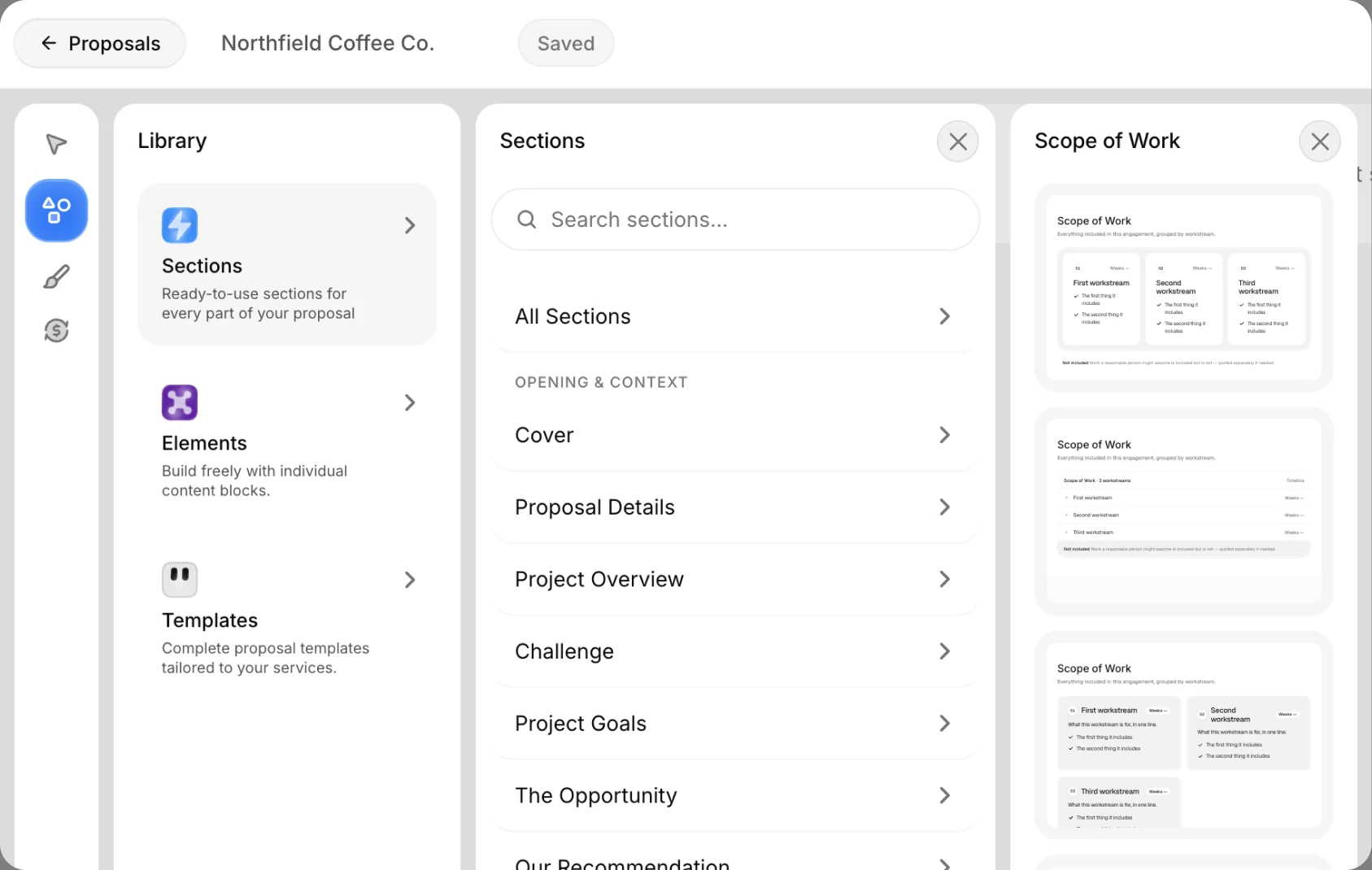
Your client reviews it on the web, can ask a question or request a change, signs the exact version they read (terms included) and can pay the deposit or amount through the same proposal flow. Start from one of the proposal templates.
FAQ
Is this scope of work template free?
Yes. Use the structure on this page with your clients, as often as you like. No sign-up needed.
Is a scope of work the same as a statement of work?
They overlap. A statement of work (SOW) is often the broader contractual document; the scope of work is the section that defines the work itself. For most service projects, the scope inside a signed proposal does the job.
How detailed should a scope of work be?
Detailed enough that a new person on either side could tell whether a request is in or out of scope without asking you.
Who signs the scope of work?
Someone on the client side who can approve both the work and the budget, and you. If the person reviewing the proposal cannot approve the budget, find out who can before you send it.
This page is a starting point, not legal advice. For large or regulated engagements, have your contract reviewed by a lawyer in your jurisdiction.
About Pegasy
Pegasy is a proposal and closing platform for modern service businesses. Create interactive proposals, structure offers and give buyers one clear place to review, decide, sign and pay.